
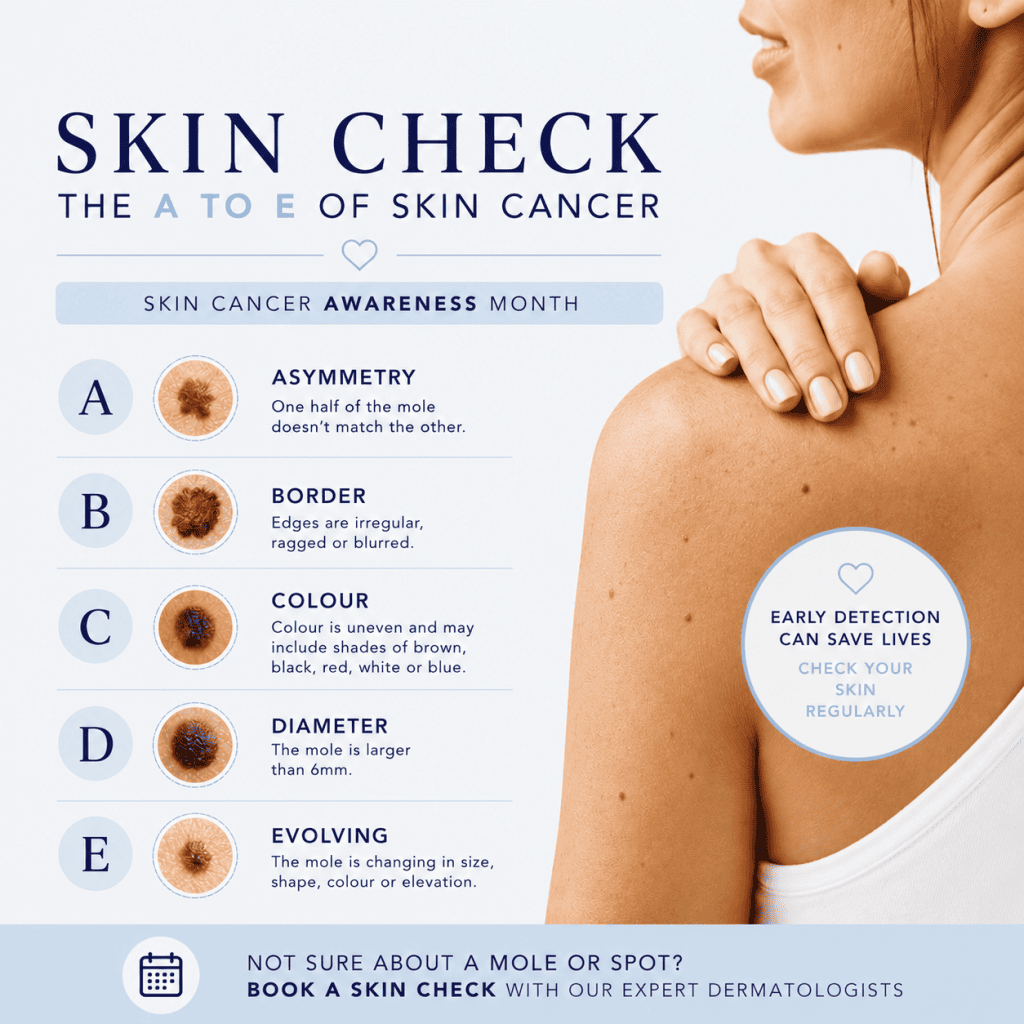
As part of Skin Cancer Awareness Month, Southface Dermatology Clinic is encouraging everyone to become more familiar with the warning signs of skin cancer and the importance of regularly checking their skin.
Early detection can save lives, and knowing what to look for is one of the most important steps you can take for your skin health.
One of the easiest and most effective ways to monitor moles and skin changes is by using the A to E guide for skin cancer detection.
What Is the A to E Guide?
The A to E guide helps identify common warning signs that may indicate a mole or skin lesion should be checked by a dermatologist.
A – Asymmetry
If one half of a mole does not match the other half in shape, size, or appearance, this could be a warning sign.
B – Border
Healthy moles usually have smooth, even borders. Be cautious of moles with irregular, ragged, blurred, or uneven edges.
C – Colour
A mole with multiple colours or uneven colouring should always be monitored carefully. Shades of brown, black, red, white, or blue within the same lesion can be concerning.
D – Diameter
Moles larger than 6mm (around the size of a pencil eraser) should be assessed, particularly if they continue to grow.
E – Evolving
One of the most important warning signs is change. If a mole changes in size, shape, colour, texture, or begins itching, bleeding, or crusting, it should be checked by a specialist as soon as possible.
Why Early Detection Matters
Skin cancer is one of the most common cancers worldwide, but when detected early, treatment outcomes are often very successful.
Many people delay getting a mole checked because they are unsure whether it is serious. However, it is always best to seek professional advice if you notice anything unusual or changing on your skin.
At Southface Dermatology Clinic, our expert dermatologists provide professional skin assessments, mole checks, and skin cancer investigations with fast access to expert care and treatment.
How to Check Your Skin at Home
Performing regular skin checks at home can help you spot changes early.
We recommend:
- Checking your skin once a month
- Using a mirror to examine difficult-to-see areas
- Taking photos to monitor changes over time
- Asking a partner or family member to help check areas such as your back or scalp
Remember to check:
- Face and neck
- Arms and hands
- Legs and feet
- Back and shoulders
- Scalp and behind the ears
When Should You Book an Appointment?
You should arrange a professional skin check if:
- A mole changes in appearance
- You notice a new or unusual lesion
- A spot becomes itchy, painful, or bleeds
- You are worried about any skin change
At Southface Dermatology Clinic, we are passionate about raising awareness around skin cancer and helping patients access expert dermatology care quickly and confidently.
If you are concerned about a mole or skin lesion, book a skin check with our specialist dermatology team today.